
 Canada - EN
 USA - EN
Sealant or Filler? How to Choose the Right Outdoor Repair Product
Grab the wrong product and your repair won't last a season. That's not an exaggeration—Canadian freeze-thaw cycles, UV exposure, and moisture are relentless, and they'll expose a mismatched product fast. A rigid filler packed into a moving joint will crack by spring. A rubbery sealant in a hole that needs painting will never give you a clean finish.
The good news? Choosing correctly isn't complicated once you know what to look for. This guide walks you through the core difference between sealant and filler, how to match the right product to the right repair, and what to look for based on your specific surface and conditions.
Sealant vs. Filler: What's the Core Difference?
Are Sealants & Filler the Same Thing?
No, even though both are used for outdoor repairs and some products blur the lines between them, sealants and fillers are best used for different applications.
Sealant, or caulk, is a flexible material used to seal joints, seams, and cracks, forming a barrier to prevent water and air from entering. Its flexibility prevents cracking as materials naturally expand and contract with the changing outdoor temperatures.
Filler is a general term used for compounds that rebuild and restore the shape of a damaged surface; think holes, gouges, dents, and rotten sections. Once dry, the strong, rigid material can be sanded smooth and painted for a seamless finish.
Choose by Function
Some specialty products are labelled as both "filler" and "sealant," which can be confusing. Focus on what the job actually needs—flexibility or structural rebuilding—and the right product category will become clear.
Impact of Outdoor Conditions
Even the right repair type can fail outdoors if the product is not designed for exterior use. Rain, UV exposure, and Canadian freeze-thaw cycles put constant stress on repairs in ways indoor applications usually do not.
In many parts of Canada, temperatures can swing from -30°C to 35°C throughout the year. This variation causes the joints around windows, doors, trim, and siding to expand and contract. High-performance exterior sealants, such as DYNAFLEX ULTRA and SILICONE ULTRA, offer the necessary flexibility to move with these joints without cracking or losing adhesion.
The highly versatile exterior filler, PLATINUM PATCH, is specifically formulated with WeatherMax Technology to withstand the elements without crumbling or shrinking, ensuring that repairs remain intact on exposed surfaces.
How to Choose by Repair Type
When should you use sealant?
Use sealant wherever the gap, joint, or seam is subject to movement or needs to stay watertight. Common outdoor applications include around window and door frames, along siding edges and trim, at flashing and gutter connections, around pipes and vents, and at concrete control joints.
PRIMARY OUTDOOR SEALANT TYPES
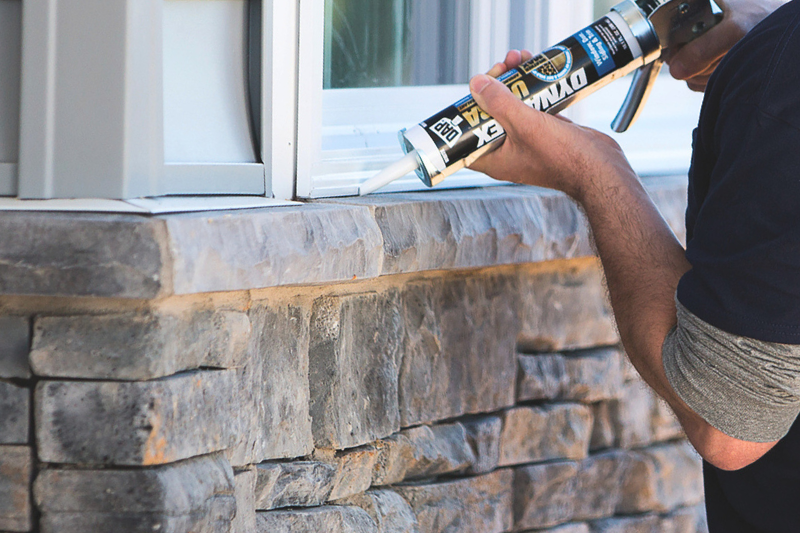
Latex sealant is paintable and cleans up with water, making it the right call for trim, wood-adjacent surfaces, and anywhere colour match matters.
DYNAFLEX ULTRA Advanced Exterior Sealant (latex-based)
DYNAFLEX ULTRA is formulated with WeatherMax Technology to resist UV fading, chalking, crumbling, and cracking—a strong fit for Canadian outdoor exposure. It adheres to a wide range of common building materials. It's rain-ready and paintable in just one hour and carries a lifetime mould, mildew, and algae resistance guarantee. Best for sealing windows, doors, siding, trim, fascia, flashing, pipes, vents, and corner joints.
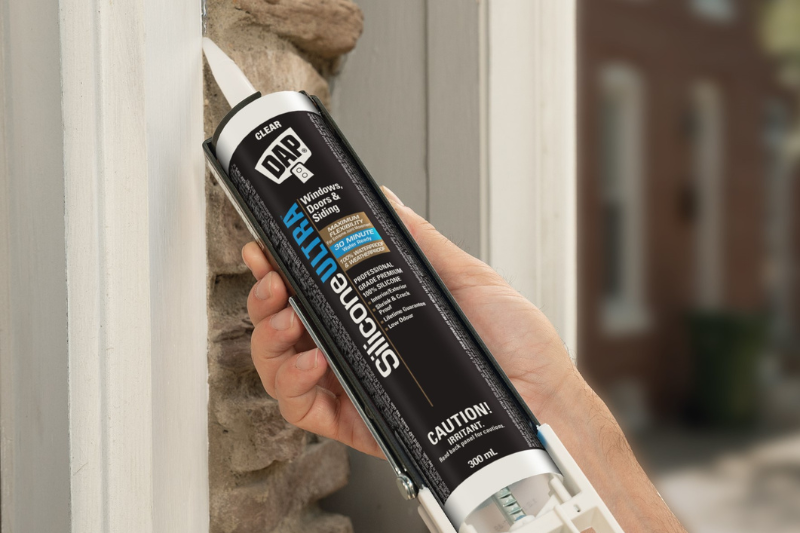
Silicone sealant offers outstanding waterproofing and flexibility. It's the better choice for non-porous surfaces, wet zones, and applications that require maximum joint movement—but keep in mind it is not paintable. Paint the substrate before applying silicone.
SILICONE ULTRA Window, Door & Siding 100% Silicone Sealant
SILICONE ULTRA delivers twice the joint movement capability of many other sealants, with a rating of ±50% dynamic joint movement (ASTM C719, Class 50). It's water-ready in just 30 minutes and provides a 100% waterproof and weatherproof seal. It adheres to most common building materials and is perfect for use on windows, doors, siding, trim, gutters, flashing, vents, pipes, and corner joints. Choose SILICONE ULTRA for non-porous surfaces, wet-zone applications, or anywhere maximum flexibility is the priority.
For gaps wider than 13 mm (½"), use foam backer rod before applying either sealant to ensure proper fill depth and adhesion.
When should you use filler outdoors?
Use filler when the damage is structural—a hole, gouge, dent, rotten section, or surface imperfection—and the repair needs to be sanded flush and painted. Filler doesn't belong in moving joints, but it's the right tool when you need to rebuild surface material and achieve a smooth finish.
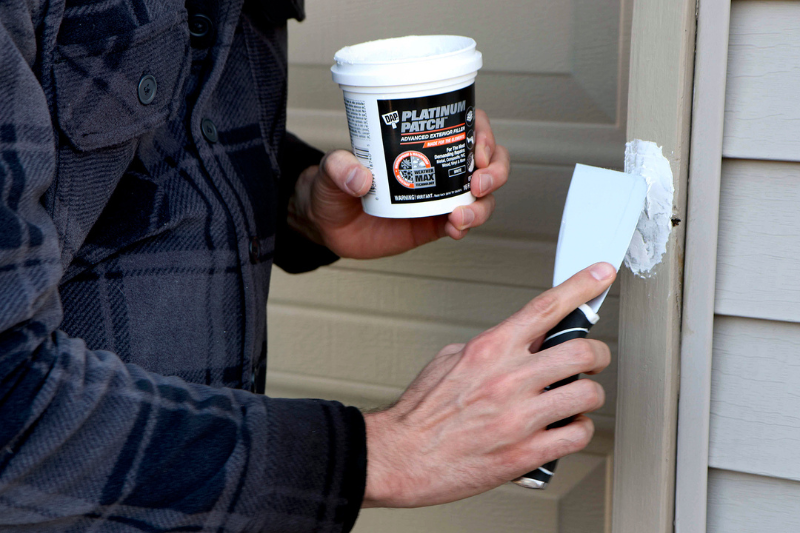
PLATINUM PATCH Advanced Exterior Filler
PLATINUM PATCH is built with WeatherMax Technology and is waterproof, weatherproof, and mould- and mildew-resistant—making it well-suited for demanding exterior repairs. It adheres to nearly every common building material. Sandable and paintable in 2 to 4 hours, depending on the repair depth, temperature, and humidity. Best for holes, cracks, crevices, and dents that need rebuilding and finishing flush with the surrounding surface. Do not use PLATINUM PATCH as a joint filler over cracks where expansion and contraction may occur.
Specialty Applications & Products
For wood-specific cosmetic repairs such as nail holes, gouges, shallow cracks, and surface defects, WOODPRO All-Purpose Wood Filler offers a more tailored finish. It is designed to look and behave more like real wood and can be sanded, cut, planed, drilled, nailed, screwed, stained, and painted once dry. That makes it especially useful for detailed repairs on trim, moulding, windows, doors, and cabinetry.
Use WOODPRO when the repair is primarily cosmetic and limited to wood. If the repair is larger, spans multiple materials, or needs more all-purpose exterior durability, PLATINUM PATCH may be the better fit.
For moving joints and edges around exterior wood trim, siding, and frames, DYNAFLEX ULTRA remains a strong choice because it is paintable and adheres well to painted and unpainted wood, cedar, and nearby materials.
Masonry, brick, and concrete have a distinct rough texture that can be challenging to replicate with traditional sealants and fillers. If your goal is to achieve a seamless blend with these materials, consider using TEXTURED MORTAR or TEXTURED CONCRETE. These products apply similarly to sealants but cure with a textured finish that mimics the surrounding mortar or concrete. They are ideal for filling cracks, seams, and joints where two surfaces made of the same textured materials meet.
For joints where masonry or concrete meets different materials, such as metal flashing, siding, or window frames, it's best to use a traditional exterior sealant.
RELATED: Concrete Repair Lineup
Reoccurring Cracks
For stubborn, reoccurring cracks in areas that shift and settle significantly year over year, consider EXTREME STRETCH Elastomeric Sealant which stretches up to 600% and offers excellent weatherability to resist UV light and temperature extremes without cracking.
Five Questions to Ask Before You Buy
Run through these before picking up a product:
- Does the repair move or expand? If yes, you need a sealant.
- What material is the surface? Wood, masonry, metal, and non-porous surfaces each have different adhesion requirements.
- Does the repair need to be painted? If yes, avoid silicone sealant.
- Does the repair need to be sanded smooth? If yes, use filler—not sealant.
- What weather and moisture exposure will it face? High-moisture or submerged applications require products rated for those conditions.
Putting It All Together
Choosing the right product for your outdoor repair doesn't have to be complicated. Start with the type of repair you're facing: if the area moves, flexes, or needs to stay watertight through Canada's freeze-thaw cycles, reach for a flexible exterior sealant. If you're filling, rebuilding, or smoothing a damaged surface, a durable filler is the way to go. Once you've made that call, you can fine-tune your choice for the specific surface—whether that's wood, masonry, concrete, or metal—to get the cleanest, longest-lasting finish.
With the right product and a little know-how, even the toughest exterior repairs are well within reach. Trust your plan, take your time, and enjoy the satisfaction of a job built to last.
Learn More
- DAP Dynaflex Ultra Exterior Sealant
- Silicone Ultra Window, Door & Siding Sealant - 100% Silicone Sealant
- Weatherproof Patching Compound
- DAP Plastic Wood Filler
- Textured Mortar Premium Elastomeric Filler & Sealant
- Textured Concrete Premium Elastomeric Latex Filler & Sealant
- EXTREME STRETCH Acrylic Urethane Premium Elastomeric Sealant